Past Projects
Book on ICWES (2024)
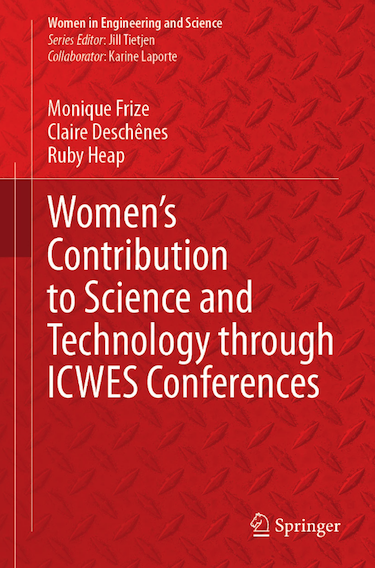
CIWES-ICWES published a book about the history of the ICWES Conferences, and creation of INWES and CIWES-ICFIS
“Women’s Contributions to Science and Technology Through ICWES Conferences”
Authors: Monique Frize, Claire Deschênes, Ruby Heap, with collaboration of Karine Laporte. Foreword by Jill S. Tietjen and Gail Mattson
Springer International Publishing, Women in Engineering and Science book series, January 2024
DOI 10.1007/978-3-031-33800-7.
This book documents the history of women in STEM (Science, Technology, Engineering, and Maths). It demonstrates the leadership and vision of women in male-dominated STEM professions, and the continuous efforts of women involved in STEM, since 1964, to establish modes of networking and sharing their contributions in STEM and gender issues. This effort was carried out by volunteers, continuing the ICWES conferences over a period of 59 years.
Over 18 chapters, the book discusses many aspects of the legacy of The International Conferences of Women Engineers and Scientists (ICWES):
- How a group of women organized a conference, in June 1964 in New York, which attracted 486 women, to present their scientific achievements and how to attract more women in STEM.
- Who were the organizers and the hosting societies of the ICWES Conferences, and what the testimonials’ reveal.
- The scientific content of the Conferences, both on technical and gender aspects, and the changes in issues over time.
- The importance of global involvement, shown through past conferences in locations such as USA, UK, Italy, Poland, France, India, Ivory Coast, Hungary, Japan, Canada, Australia, New Zealand, and South Korea.
- How the efforts were aided by the development of the NGO International Network of Women Engineers and Scientists (INWES), which ensures the continuation of the conference series.
- What is included in the conference database, which is available at the Canadian Archive of Women in STEM, University of Ottawa Library.
- Research questions that could be pursued using the database on ICWES Conferences.
The authors hope that everyone interested in the topic of women in STEM, – and especially INWES members -, will be drawn to the history of the ICWES conferences, which led to the creation of INWES and CIWES-ICFIS. They also hope to inspire women and girls, men and boys, to study and work in STEM fields.
Review of Books by Paul Dufour, Senior Fellow, Institute for Science, Society and Policy, University of Ottawa
Published in CIWES-ICFIS Annual Report 2023-2024
You know the numbers. Fair representation of women and girls in science, digital literacy and engineering (especially the latter) has always been an uphill battle. Just citing Canadian numbers from 2023, women make up less than 25% of people employed in STEM careers,and 34% of Canadians with a STEM degree are women. The data, while improving, are not much better elsewhere. In addition, according to recent UN metrics, women are typically given smaller research grants than their male colleagues and, while they represent 33.3% of all researchers, only 12% of members of national science academies are women. In cutting edge fields such as artificial intelligence, only one in five professionals (22%) is a woman. Women still account for only 28% of engineering graduates and 40% of graduates in computer science and informatics. Female researchers tend to have shorter, less well-paid careers. Their work is underrepresented in high-profile journals and they are often passed over for promotion.
But of course, numbers are not the whole story. Now in its 10th year, the UN sponsored International Day of Women and Girls in Science has helped shine a spotlight on some of these challenges. Awards such as the annual L’Oreal-UNESCO laureates for women in science have addressed the need to promote more attention to gender equity as have the rise of outreach and training movements for girls in STEM education.
At the end of the day, though, lived experiences, shared lessons, mentoring, outreach opportunities, overcoming barriers to entry, advocacy, early childhood education experience, cultural, family influences and other issues also matter.
In the mid-1960s, women leaders in science and engineering took it upon themselves to change and reshape the situation while sharing successes and lessons learned, and also discussing how to move the dial on enhanced representation in all fields.
The International Conferences of Women Engineers and Scientists were a major platform for this.
This book is a labour of love and commitment for the authors and its contributors. It is a large book coming in at 468 pages and relies heavily on a rich, digitized collection of conference notes, testimonials and proceedings that took place from 1964 to 2002. The three authors–who have a distinguished pedigree in engineering and science from Canada—have done a remarkable job winnowing down the essentials of the meetings that took place—from the very first gathering in 1964 of the International Conference of Women Engineers and Scientists (ICWES) in New York City to the creation of the INWES (International Network of Women Engineers and Scientists) which today ensures the continuity of the first ICWES conference now into its 19th edition having taken place in New Zealand in 2023.
The authors are quick to point out that there existed several other women in science and engineering organizations before the early ‘60s and they list some of these. But, with respect to the global ICWES conferences, the reader will be struck by the tremendous science and engineering dialogues—not to mention diplomacy—that took place. Clearly, the range of venues for the conferences led to ongoing friendships, partnerships and mentorships that can only grow within the networks that were created across the world.
We learn from this historical account covering 1964 to 2002 that each of the conferences had major themes to help generate focused debates, discussions and action in promoting the place, the promotion and the recognition of women in science and engineering, wherever they existed with local research communities, associations helping to shape the event.
Over its first 14 ICWES conferences covered in this book, the globe was their oyster– with events in Asia, Africa, North America, Europe. Take for example the 1987 conference in Abidjan, Ivory Coast where the subject focus was science, technology and development opened by the then head of state. Supported by the Cercle Ivoirien des femmes ingénieurs, scientifiques, architectes, et techniciens, almost 220 participants came from 31 countries giving papers on such topics as nutrition and agriculture, science and the law, and cultural conservation considerations for environmental development. Resolutions were passed by delegates with recommendations. Several of these remain pertinent today.
For instance, that in each country, a day be established to recognize the accomplishments of women in science and technology, and that women engineers and scientists be encouraged to become role models in order to publicize their ability to combine successfully both professional and family life.
In another example, the 10th ICWES conference in Budapest took place in 1996 as the UNESCO World Science Conference was being organized (that 1999 conference remains pivotal to this day for many reasons). The theme of the ICWES conference was, appropriately, ‘Towards the Third Millennium: The Role of the Intellectual Potential in a New World.’ With over 80 participants discussing new trends in natural sciences and technology and the transfer of knowledge, two research studies using computer science to support medical personnel merit some attention. One of these was by an author of this book, Monique Frize, who, with her students, presented CIWES-ICFIS Annual Report 2023-2024 5 a paper called computer-assisted decision systems for medical application—issues that today in our post-COVID world with its healthcare impacts can resonate.
The testimonials from individual delegates that follow each of the meetings from participants provide a rich interpretation of issues that took place with various personal perspectives and, while this reviewer cannot possibly do these full justice, they are worth reading in some detail, including and especially, the opening talk by Rita Levi Montalcini at the Turin, Italy ICWES conference in 1971 where she argued that: the women’s problems, as I see them, are not so much or at least not only to make full use of the reservoir of intellectual energies untapped for centuries, as to give to women the full measure of their intellectual talent and dignity as human beings.
The ICWES conferences tended to be forwardlooking, often anticipating changes in society, science, and engineering. Not surprisingly, presentations were not simply about science or engineering, but also incorporated the full range of knowledge (le savoir), culture and language. They were also attentive to next generation talent with youth participation poster sessions and special panels.
In 2002, a landmark conference took place in Ottawa, Canada, the 12th ICWES. Chaired by Monique Frize with the program president Claire Deschênes (two of the authors of this book), the event brought together over 500 participants from more than 49 countries presenting over 200 papers with the theme of ‘Women in a Knowledge- Based Society.’ Climate change was a major focus via a symposium and panels that brought together leading researchers in the field discussing the role of oceans as a climate moderator and implementation of the Kyoto Protocol in Latin America. Sustainable development also figured prominently with agriculture and energy issues being discussed by several African panelists.
Gender papers that were presented also highlighted the role of Indigenous knowledge and importantly as well, the meeting helped launch a new association for francophone women researchers. Gender mainstreaming was also brought to the table via a major study for reaching gender equality. The Canadian experience with research chairs for women in science and engineering noted the progress to date.
But a highlight of the conference was a business meeting to discuss the creation of something beyond the conferences— to effectively institutionalize a new network—a proposal to establish an International Network of Women Engineers and Scientists. This was built in part on a resolution from the 1999 UNESCO World Science Conference which had adopted a statement encouraging the development of a ‘global network’ of women engineers and scientists. And indeed, one of the authors of this book, Claire Deschênes, was a Canadian delegate to that event and brought back the concept of this network to the ICWES. A meeting had previously been held in May 2001 in Merrickville, Ontario to discuss the structure and funding of such a network (discussed further in the book). Thus, INWES was born. It was designed to “Strengthen the capacity of individuals, organizations, and corporations through education and professional development to encourage the participation of women in Science, Technology, Engineering, and Mathematics (STEM) worldwide through an international network of organizations and experts.” With the goal of: “Building a better future worldwide through full and effective participation of women and girls in all aspects of Science, Technology, Engineering, and Mathematics (STEM).” The foreword to the book by Gail G. Mattson, a past President of INWES, notes the progress of INWES in now being aligned with two of the major gender mainstreaming objectives of the UN Sustainable Development Goals.
The remainder of the book covers the new INWES and its meetings from 2002-2008 which took place in various countries including in France and Korea. Moreover, the book summarizes two other ICWES conferences in Seoul and Lille. An added feature has a chapter covering the evolution of what is today the Canadian Institute for Women in Engineering and Sciences along with the creation of growing archival material of women in science and engineering housed by the Canadian Archive on Women in STEM at the Library of the University of Ottawa. (Note: the reviewer is a CIWES Board Member).
Overall, this book is a major contribution to the extensive literature surrounding issues and challenges for women in engineering and the sciences. It highlights the continued leadership and advocacy of passionate and articulate promoters in the field. The authors rightly conclude with some outstanding questions for the ICWESINWES experiment that continues. These include:
- How did the broad and complex issues concerning the participation and retention of women in S&T evolve over time?
- To what extent did (do) ICWES conferences serve to illustrate and document the reciprocal relationships between science and society?
- How were (are) the scientific interests distributed between regions at the beginning of these conferences and how did they change over time through the global dialog?
The book clearly deserves a broad readership as it underscores the still remaining challenges facing gender inequities across the world. While many of these continue to be discussed and debated among multilateral groups such as the G20 and G7, the UN and various NGOs, there is still much work to be done.
CCWE+20: A Workshop on Women in the Engineering Profession
The INWES Education and Research Institute are pleased to provide its many readers across Canada, the USA, and the world with the final report of its most recent project and great success: the CCWE+20National Workshop held in Ottawa (Canada), April 29th and 30th, 2011.
CCWE+20 Final Report
Documents
The Canadian Committee on Women in Engineering (CCWE) was active from 1990 and 1992, the result of their activities produced a comprehensive report More Than Just Numbers detailing the issues, goals, and recommendations for women in engineering. On April 29th and 30th, 2011 the committee gathered at the University of Ottawa to conduct a twenty year review workshop. The workshop gathered committee members, key stakeholders, students, and people from industry to examine past recommendations, current issues, and develop new recommendation for the decade to come.
Below are all the documents that were presented throughout the duration of the conference.
A2. CCWE+20 Conference Speakers: PowerPoint Presentations
- Monique Frize: Historical Background
- Valerie Davidson, Julita Vasseliva, Elizabeth Croft – NSERC Regional Chairs:Report to CCWE+20
- Isabelle Blain and Enikö Megyeri-Lawless – NSERC: Maximizing Opportunities: Increasing Women’s Participation in Science and Engineering – A Summit.
- Axel Meisen – UNESCO and Engineering: UNESCO and Engineering Shaping the Future.
- Crystal Sissons – UOWERG report: Retracing Paths to Advance Future Journeys.
- Paula Leventman: Women in Engineering in the United States. Overview 1990-2010.
- Catherine Mavriplis – National Science Foundation: ADVANCE Program
CCWE+20 Conference Speakers: Presentation Notes
- Chantal Guay: Female Representation within the Engineering Profession.
- Claude Laguë – NCDEAS:Quick facts/ Observations on issues related to women in engineering since 1992 / Looking forward.
B. Conference Documents
- The Workshop Program/Programme
- The Menu and Logos
- Questions to guide discussion groups
- Press Release with logos
- Evaluation CCWE+20 /Évaluation CCFI+20
C. Reference Documents
The Canadian Committee on Women in Engineering (1992), produced a comprehensive report More Than Just Numbers Report details the issues, goals, and recommendations for women in engineering The Canadian Committee produced a summary report derived from the original report, More Than Just Numbers Summary.
Le Comité canadien des femmes en ingénierie a lancé son rapport final Elles font une différence en 1992. Le Rapport du Comité canadien des femmes en ingénierie – Avril 1992 (rapport intégral) et le Rapport du Comité canadien des femmes en ingénierie (sommaire) font tous deux état des questions soulevées au cours des deux années d’activité, établissent des objectifs clairs pour l’avenir, et formulent des recommandations réalisables pour accroître la participation des femmes dans la profession.
Media
PRESS RELEASES:
- INWES Education and Research Institute (ERI) Canadian Committee of Women in Engineering (CCWE+20) national workshop recommendations press release.
- L’INWES Education and Research Institute (ERI) Comité canadien des femmes en ingénierie (CCFI+20) recommandations de l’atelier national communiqué de presse.
Sponsors
Platinum

Gold

Silver

Bronze
